
Why Your Senior Dog Deserves a Seat at Your Northern Colorado Wedding
Your 12-year-old golden retriever walked you through breakups, cross-country moves, and the day you got engaged on that trailhead near Horsetooth. Now you’re planning a wedding at a mountain venue, and the thought of leaving her behind feels impossible—but so does managing her arthritis, medication schedule, and anxiety in a chaotic ceremony environment.
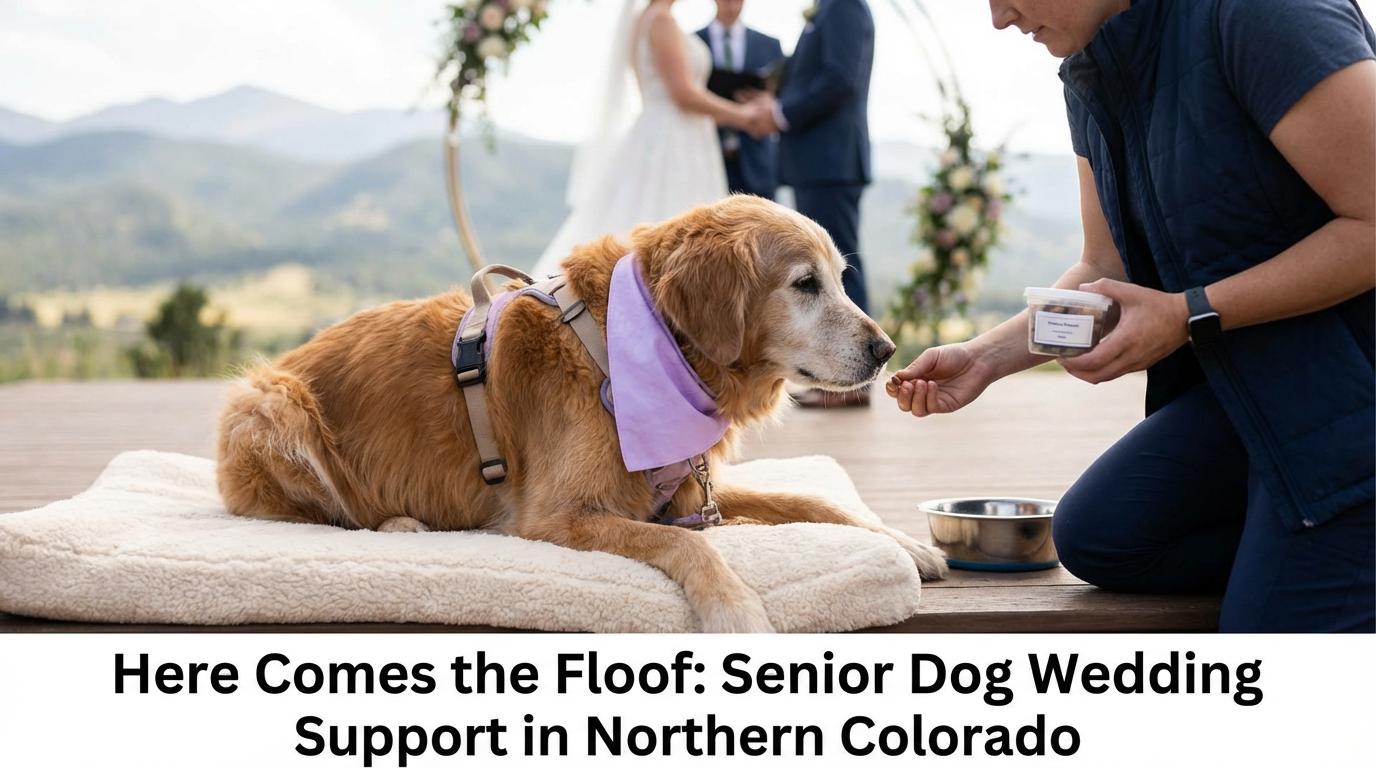
Senior dogs require a different level of care than their younger counterparts, especially at high-altitude Colorado weddings. Here Comes the Floof specializes in senior dog wedding support that goes beyond basic pet attendance. We manage the medical, logistical, and emotional needs of aging fur babies so you can focus on your vows instead of whether your dog took his joint supplement.
This checklist walks you through everything you need to prepare your senior dog for your big day—from altitude considerations to mobility support.
The Senior Dog Wedding Support Checklist
Medical Prep (Start 4–6 Weeks Before)
Schedule a Vet Clearance Appointment
- Request a written health assessment specifically mentioning altitude tolerance (critical for venues above 7,000 feet)
- Confirm all vaccinations are current—many Colorado ranches and event spaces require proof
- Discuss anxiety management options: Does your dog need a mild sedative for the car ride, or will a ThunderShirt suffice?
Create a Medical Briefing Document
Include:
- Current medications with exact dosing times
- Mobility limitations (Can she handle gravel paths? Does she need assistance on stairs?)
- Triggers for reactive behavior (Does he get “spicy” around children in formal wear?)
- Emergency vet contact for your wedding location
Pack a Senior-Specific Care Kit
- Joint supplements and any prescription meds in labeled containers
- Orthopedic blanket or cooling mat (temperature regulation declines with age)
- Collapsible water bowl and electrolyte powder for hydration at altitude
- Puppy pads in case of incontinence episodes
- Favorite comfort item that smells like home
Altitude & Environment Considerations for Northern Colorado Venues
Understand the Elevation Impact
A 10-year-old pug who’s fine at Fort Collins’ 5,000 feet may struggle at a ceremony site near Estes Park at 8,500 feet. Senior dogs are more susceptible to altitude sickness because their cardiovascular systems are less adaptable.
Warning signs to monitor:
- Excessive panting or drooling
- Disorientation or stumbling
- Blue-tinged gums
A professional wedding pet attendant monitors these symptoms throughout the event and knows when to move your dog to a lower-elevation safe space with oxygen-rich airflow.
Weather Volatility
Mountain weather shifts fast. Your senior dog can’t thermoregulate like he used to, so:
- Bring a cooling vest for summer ceremonies (even at altitude, direct sun is intense)
- Pack a fleece jacket for evening receptions when temperatures drop 30+ degrees
- Identify a climate-controlled backup location at your venue
Logistics: The Pet Taxi Solution
The Getting-Ready-Day Problem
You’re at a cabin in Allenspark doing hair and makeup for four hours. Your dog needs her 10 a.m. medication, a bathroom break, and can’t handle the chaos of curling irons and champagne toasts.
The Solution:
Our wedding pet attendant packages include pet taxi service designed for senior dogs:
- Climate-controlled vehicle transport with orthopedic bedding
- Medication administration on your exact schedule
- Calm, quiet holding environment away from pre-ceremony stress
- Timed arrival so your floof appears for photos, then returns to a comfortable suite during the reception
Mobility Assistance
If your dog has hip dysplasia or arthritis:
- We use support harnesses for navigating uneven terrain
- We carry portable ramps for vehicle entry/exit
- We coordinate with your photographer for stationary photo setups instead of making your dog walk long distances
Behavioral Management for Reactive Senior Dogs
The “Spicy” Senior Reality
Older dogs often become more reactive due to:
- Hearing or vision loss (they startle easier)
- Pain-related irritability
- Cognitive decline that reduces stress tolerance
Our Approach:
- Pre-event consultation to understand your dog’s specific triggers
- Designated handler who stays with your dog 100% of the time (no multitasking with other pets)
- Strategic positioning during the ceremony: close enough for you to see him, far enough from guest foot traffic
- Exit plan if your dog shows stress signals—we remove him to a quiet safe space without disrupting your ceremony
The “No FOMO” Promise
Your senior dog doesn’t need to attend the entire 6-hour reception. The most meaningful moments are:
- Getting ready photos (15 minutes)
- Ceremony presence (30 minutes)
- Formal portraits (20 minutes)
After that, most senior dogs are exhausted. We transport them back to your accommodations for rest, medication, and dinner on schedule.
Venue Compliance & Insurance
Ask These Questions 4+ Weeks Out:
- Does the venue allow dogs, and are there breed or size restrictions?
- Are there designated relief areas, or do we need to walk to a trailhead?
- Is there an indoor backup space if weather turns?
- Do they require proof of liability insurance? (Professional pet attendants carry this; your cousin volunteering to “watch the dog” does not.)
The Ranch/Outdoor Venue Wildcard
Colorado wedding venues near Red Rocks, Lyons, or the high desert often have:
- Wildlife (deer, foxes) that trigger prey drive
- Cattle guards and gaps in fencing
- Loose gravel that’s hard on arthritic joints
A professional wedding pet attendant scouts these hazards in advance and plans accordingly.
Day-Of Timeline for Senior Dog Wedding Support
Sample Schedule:
- 8:00 a.m. – Pick up from your Airbnb, morning meds administered
- 8:30–11:00 a.m. – Quiet suite time with bathroom breaks every 90 minutes
- 11:15 a.m. – Getting-ready photos with pet parents
- 12:00 p.m. – Return to suite, lunch, rest
- 2:45 p.m. – Arrive at ceremony site, final bathroom break
- 3:00 p.m. – Ceremony (attendant holds leash off-camera)
- 3:30 p.m. – Family portraits
- 4:00 p.m. – Transport back to accommodations for evening rest
This schedule prevents exhaustion while ensuring your fur baby is present for the moments that matter.
Don’t Leave Your Best Friend Behind
Your senior dog has earned a place at your wedding. With the right support system, you can include your fur baby without the logistical overload or medical anxiety.
Ready to plan senior dog wedding support for your Northern Colorado ceremony? Contact us today to discuss your dog’s specific needs, venue logistics, and how we’ll make sure your oldest friend is safe, comfortable, and celebrated on your big day.
FAQ: Senior Dog Wedding Support
My 13-year-old dog is on four different medications. Can you handle that?
Yes. We follow your exact medication schedule, including time-sensitive doses. During our pre-wedding consultation, we review each medication, dosing instructions, and any food requirements. We also photograph each administration and text you confirmation so you have zero worry on your wedding day.
What happens if my senior dog has an accident or medical emergency during the ceremony?
We have a three-tier response plan. For minor issues (incontinence, vomiting), we discreetly remove your dog to handle cleanup without disrupting the ceremony. For moderate concerns (excessive panting, disorientation), we move to a cool, quiet space and monitor vitals. For emergencies, we have pre-identified the nearest veterinary clinic to your venue and will transport immediately while keeping you informed.
My dog can’t walk long distances anymore. Can she still be in outdoor wedding photos?
Absolutely. We coordinate with your photographer to bring your dog to stationary photo locations using supportive harnesses or carrying her if needed. We also bring portable water, a rest mat, and plan photo sessions in shorter intervals (5–10 minutes) to prevent exhaustion. The goal is meaningful presence, not physical endurance.